Tag Archive: asma al husna


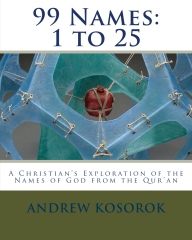
The first book for The 99 Names Project, 99 Names 1 to 25, is out and people have really enjoyed it.  When Chris Blauvelt at LaunchGood.com found out a Christian had done this, he was very happy.  He and his team were so impressed, they talked to me to see how they could help The 99 Names Project succeed in its mission of building bridges among neighbors through glass sculptures of the 99 Most Beautiful Names of God, and in finishing the books for the series.

“Something like this is really needed!”  I was told.  “It is inspiring not just to Christians and Muslims, but to people of every faith to show what we can do to draw closer to our neighbors.  Just imagine how wonderful it would be if people all over the world did things like this!”

I began The 99 Names Project to share what I, as a Christian, was learning about the many hues of Islam around the world as I built stained glass sculptures for each of the traditional Names of God from the Qur’an.  It is exciting as I move forward with the next leg of the journey, completing the sculptures for Names 26-50.  One of the early goals for the Project was to have exhibits in 99 different cities in the US and around the world; progress for this has been slower than hoped, but with the help of Chris and his team at Launchgood.com, and the many supporters all around the world, this is becoming a wonderful reality.

To celebrate the launch of the Project today, if you “like” The 99 Names Project facebook page and send me your email, I will send a PDF copy of the first book for the Project, 99 Names 1 to 25, completely free.  Come by the LaunchGood.com site for the Project and donate!  And feel free to share it with all your friends!  I would love to do an exhibit in your home town, and I’m so grateful you’re helping me share this project – making the world safer and happier as we learn to appreciate and love our neighbors.

All Project photography by Hawkinson Photography

The first two Names in lists of Asma al-Husna are Ar Rahman and Ar Rahim, The Compassionate and The Most MercifulCompassion and mercy are so connected, that the translations of these two Names overlap quite a bit.  Almost every chapter in the Qur’an begins with a pronouncement of these two Names, reminding the reader of the greatest qualities of the Author and Creator of the universe.  From a Christian viewpoint, the traits of Divine compassion and mercy are perhaps the most closely linked in our minds with the mission of Christ – our relationship with God should be one of comfort and security, with the realization that God welcomes all who approach in humility.

The palm trees symbolize an oasis, a place of comfort and refuge filled with cool, life-giving living water.  In my studies, I discovered something that struck me as being rather cool.  European alchemists and Muslim alchemists both sought for the secret of transmuting base matter into gold, as a metaphor for the transformation of the natural man into a being worthy of salvation.  However, many Muslim alchemists also searched for the panacea, the perfect medicine which would heal all ills.  This was a red powder and also referred to as the Scarlet Robed King.  The vial in the “oasis” of palm trees is filled with a red powder, representing the universal medicine.

The pattern on the floor and back wall is made from a traditional Islamic eight-pointed star and cross pattern referred to the “Compassionate Breath” – the stars represent inhales and the crosses exhales, and the idea comes from a passage in the Qur’an reminding us that God looks upon His creations with Compassion in every breath He takes.  The cycles of moons in the arches represent the passage of time and is a reminder that our Creator’s awareness of us extends through and beyond all time.  The designs on the sides are construction diagrams for development of the “Compassionate Breath” motif, to suggest that God’s desires for our welfare, His Divine compassion for us, was a vital part of the very design of our universe.

All of us carry, to some degree or another, the desire to receive compassion – our hopes are strengthened and echoed as we show the compassion we desire to those around us.  As with many truly worthwhile things, it seems the more we give the more we receive.